UnidoRecruitingNATIONAL

  • Subscribe to our RSS feed.
  • Twitter
  • StumbleUpon
  • Reddit
  • Facebook
  • Digg
Showing posts with label bonds. Show all posts

Thursday, 20 June 2013

Warning: Deflation is on the horizon

Posted on 08:21 by Unknown
As we know, Ben Bernanke sinked the markets yesterday and this has consequences.


As the premium on silver of some silver miners soars to 30%, we are getting to a point where mining companies are actually losing money, especially when they have mining projects in development. At these prices, nobody is going to invest in exploration companies as they would lose money in doing so.


On the other front, namely bonds, we see the U.S. treasury market decline in price while yields rise.

These high yields in bonds and mortgage yields will in turn crash the stock market and the housing market respectively, if the Federal Reserve stops its monetary easing.

These events are very deflationary, if Ben Bernanke doesn't up its QE, we will need to position ourselves in deflationary assets like cash and bonds.

Michael Pento warns for deflation in this status update.
http://www.pentoport.com/mp3/MRC130619.mp3
Read More
Posted in Ben, Bernanke, bonds, deflation, Gold, Michael, Pento, silver | No comments

Friday, 10 May 2013

Percentage of U.S. Government Public Debt held by Foreigners

Posted on 00:46 by Unknown
This page is created to monitor the Percentage of U.S. Government Public Debt held by Foreigners.

The debt held by foreigners can be found here.

From the chart we can conclude that an ever increasing amount of the U.S. Government Public Debt is financed by foreigners. As long as the chart keeps increasing, U.S. bonds are in demand by foreigners. Once this chart starts to decline, it means that confidence of foreigners in U.S. debt is starting to wane.


Read More
Posted in bonds, Debt, foreigners, public | No comments

Saturday, 20 April 2013

Money Velocity Vs. Bond Yield

Posted on 03:14 by Unknown
This page is created to monitor the Money Zero Maturity Velocity (MZM velocity) Vs. 10 Year U.S. Treasuries.

Historically, both are correlated. If money velocity picks up (blue chart), 10 Year U.S. Treasury Yields will rise (red chart).


Read More
Posted in 10, bonds, maturity, money, MZM, treasuries, U.S., velocity, year, zero | No comments

Thursday, 4 April 2013

The Significance of Japan's Bond Buying Program

Posted on 10:46 by Unknown
On April 4, 2013, Japan announced one of its boldest quantitative easing programs in history. The Japanese central bank said it would buy $530 billion of Japanese government bonds per annum, which is $44 billion per month. This amount is comparable to the $45 billion the Federal Reserve is printing to buy U.S. longer-term treasuries. But if you compare this amount to the balance sheet and the GDP of both countries, we get a different picture.

The U.S. currently has a balance sheet of $3.2 trillion while the Japanese central bank has a balance sheet of $1.8 trillion, which is half the Federal Reserve balance sheet. U.S. GDP is at $16 trillion, while Japanese GDP is at $6 trillion, which is less than half the U.S. GDP. Still, Japan is buying an equal amount of domestic government bonds at ultra-low yields of 0.45% on the 10 year Japanese government bonds (Chart 1).

Chart 1: Japanese 10 Year Treasury Yield
I cannot stress enough how important this new Japanese program is to the precious metals market, bond market and currency markets, as these are not insignificant numbers. In a previous post I pointed out that Japan had a very dire fiscal situation with record budget deficits, interest payments and a large deficit to outlay ratio. Well, the numbers have gotten worse according to the latest report of the ministry of finance of Japan.

To get into the abysmal numbers, go here.
Read More
Posted in bonds, Japan, QE | No comments

Friday, 25 January 2013

Federal Reserve Surpasses 3 Trillion Dollar Balance Sheet

Posted on 09:50 by Unknown
As of this week, the Federal Reserve has officially gone over $3 trillion in its balance sheet. It is buying MBS and bonds as promised. Of course this has consequences as I pointed out here. The euro made a 1 year high against the U.S. dollar. U.S. bond yields are breaking resistance at 1.92% yield on the 10 year treasuries.

What's very odd is that the gold price keeps languishing. A weak dollar environment should be very bullish for gold.

Chart 1: Federal Reserve Balance Sheet
Table 1: Federal Reserve Balance Sheet (detailed)

Read More
Posted in bonds, federal reserve, Gold, MBS | No comments

Saturday, 19 January 2013

Correlation: Real Interest Rates Vs. Gold Price

Posted on 12:19 by Unknown
I came across a Zerohedge chart and tried to duplicate the chart.

The chart is about how gold goes up when real interest rates (adjusted for inflation CPIAUCSL) on 10 Year Treasuries approach zero.

And as you can see, the red line (10 year treasuries adjusted for inflation) is now exactly at zero. So that is bullish for gold.

The red chart right = Yields on 10 year treasuries adjusted for CPI.
The green chart left = Percentage change in Gold.

Chart 1: Gold (% change) Vs. Real 10 Year Interest Rates (% change)
Very interesting correlation and tool to monitor.
Read More
Posted in 10 year treasuries, bonds, correlation, Gold, inflation, zerohedge | No comments

Friday, 18 January 2013

Nice Site to get Current COT Reports

Posted on 10:44 by Unknown
I always thought by myself, how come the COT site doesn't give current charts and current tables here. I mean, those numbers are 2 months old... Because of that, I didn't have current information. But we have a breakthrough here.

Thanks to Dieuwer from Seekingalpha, who pointed out I make a lot of mistakes, I now have a very interesting site to share. Namely: http://www.cotpricecharts.com/commitmentscurrent/

On that site, the two most important ones for me are the one for silver/gold and the other for 10 year bonds.

Gold: http://snalaska.com/cot/current/charts/GC.png
Silver: http://snalaska.com/cot/current/charts/SI.png
10 year bonds: http://snalaska.com/cot/current/charts/TY.png

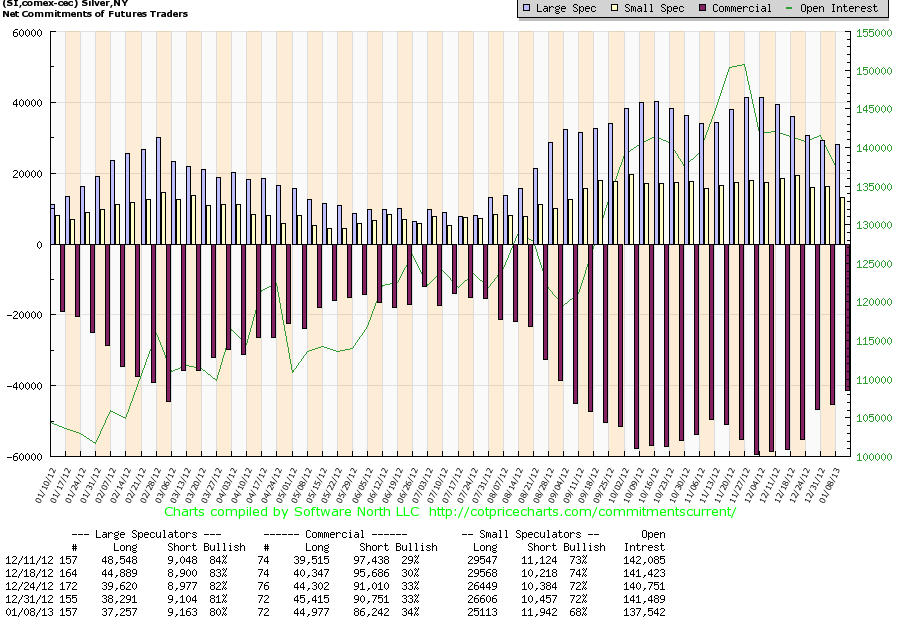
Let's talk about the silver one first. Chart 1 gives us immediately the commercial interest. And we see that today the commercials are pretty short silver. That means that silver will be weak at this time.

Once the commercials start to become long again (purple chart goes up), like in July of 2012, then you need to start buying silver. And indeed, when you look at the silver price in July 2012, it bottomed out. So this COT site, is a must, to monitor each week.

Chart 1: Silver Open Interest
Chart 2: Silver price
As for the 10 year bonds, Chart 3 gives us an idea what the commercials are doing now. They have gone long just recently. You can see the purple chart has gone positive the previous week. How to read this chart? When the purple chart is very positive, with many commercials buying bonds, like in April 2012, then you should buy bonds. When commercials are short, like in October-December 2012, you should sell bonds.
And it works like candy...

Chart 3: 10 Year Treasuries Open Interest
Chart 4: 10 Year Treasury Yields
It's like Dieuwer has just put money in my pocket with these charts!
Read More
Posted in bonds, COT, report, silver, treasuries | No comments

Wednesday, 16 January 2013

China keeps buying U.S. Treasuries

Posted on 08:16 by Unknown
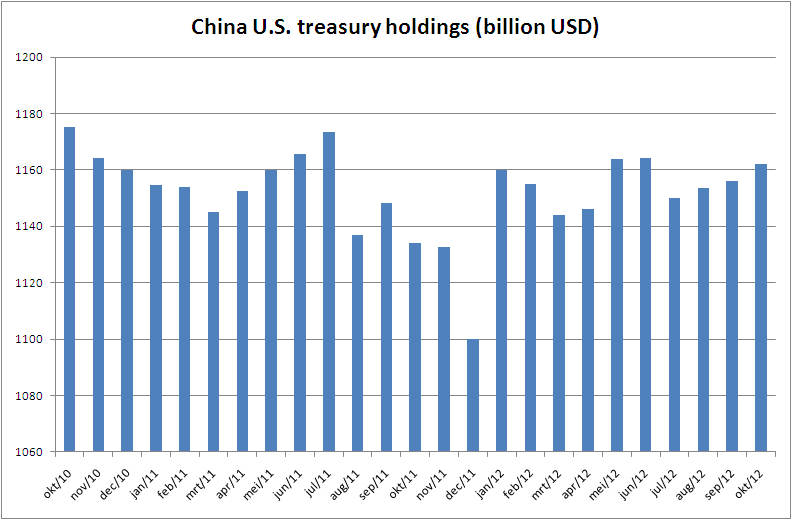
I had expected that China wouldn't buy as much U.S. treasuries in November 2012 because they bought a lot of gold (62 tonnes or $3.2 billion). But they did increase their U.S. treasuries by $200 million to $1.17 trillion.

Though, I think that China hasn't bought a lot of treasuries in December 2012 as yields were rising that month. But no worries, Japan is going to buy all the leftovers from China. Japan is almost overtaking China with its $1.133 trillion in U.S. treasuries, supposedly to devalue the yen to increase exports.
Chart 1: China U.S. treasury holdings

Read More
Posted in bonds, China, treasuries, U.S. | No comments

Thursday, 3 January 2013

U.S. bonds hit 8 month low

Posted on 14:10 by Unknown
U.S. bonds have finally broken down and from here on it's only going downwards as resistance is broken.

The funny thing is that Ben Bernanke has shot himself in the foot by telling everyone he's going to stop buying bonds at the end of 2013. The result, everyone flees U.S. bonds today. I guess Jim Rogers' call for a collapse in bonds was a hit right on the head of the nail.
Chart 1: 10 year U.S. bonds
The even odder thing we saw today is that the U.S. dollar went up 1% against the euro which is very contradictory. Normally the U.S. dollar goes down when the bond market goes down as seen in this correlation. So I think this is a temporary phenomenon. U.S. dollar strength won't last long with a weak bond market. Max Keiser is even predicting the end of the U.S. dollar in 2013. I think he's onto something.


If the Federal Reserve really were to stop buying U.S. bonds, bond yields would spike, mortgage rates would spike. The debt burden would increase tremendously with higher yields, which will bring interest payments much higher. If interest payments go higher, the budget deficit will increase when social security, defense, health care, education and pension spending isn't cut. Higher budget deficits asks for higher taxes to reign in the budget deficits and that will make stocks decline. That would lead to a start of a depression era.

You would think that the U.S. dollar would strengthen, but how can a currency strengthen with an exponentially higher debt burden and higher interest payments? It can't. First, the bond holders need to lose big before a recovery can even start. The only true safe haven will be precious metals.
Read More
Posted in bonds, keiser, max, max keiser, treasuries | No comments

Wednesday, 26 December 2012

Added Kyle Bass as Guru

Posted on 16:28 by Unknown
I decided to add Kyle Bass to the list of gurus on this blog.

He seems like a smart guy, knowing a lot about debt. And he is pro-gold.

Most important is that he says Japan is going to have a bond bubble crisis as early as next year (2013). I talked about this here and it shows that revenue of Japan is quickly going down, while interest expense is just being kept low by printing yen to buy government bonds. But, the interest payments as a percentage of tax revenues is rising, even when rates are being kept low. I said there is a point where it doesn't work anymore.

That point has arrived: The problem is, if the current account goes negative, which is already happening now, the fiscal deficit can't be maintained any longer (previously, the current account surplus was higher than the fiscal deficit. Not anymore now). Meaning, the tax revenues will eventually all go to the payment of interest on debt.

Result: implosion of Japanese bond market and nominal rise of Japanese equities. Japanese pension funds will buy huge amounts of gold. (BTW, Nomura has already surged a lot, maybe it's time to cash in the profits)

Watch his 2012 seminar here:
http://www.youtube.com/watch?v=JUc8-GUC1hY
Read More
Posted in bonds, Japan, Kyle Bass | No comments

Monday, 24 December 2012

Correlation between Bonds and Gold

Posted on 00:09 by Unknown
Just to be sure that I have this picture (and correlation) logged onto this blog, here is the famous Zero Hedge bonds Vs. gold chart.

Chart 1: Bonds Vs. Gold

And here is my updated version based on the charts GOLDAMGBD228NLBM and DGS10:
Chart 2: Bonds Vs. Gold

The decoupling of the two charts seriously went into overdrive from 2008 onwards. Guess what, that year marks the start of the QE programs to keep interest rates low. I wonder which one of the two charts will be the ultimate loser. (it won't be gold because marginal cost of production is $1500/ounce)


Read More
Posted in bonds, correlation, Gold | No comments

Tuesday, 18 December 2012

China U.S. Treasury Holdings Steady

Posted on 15:19 by Unknown
Nothing spectacular to report in the Chinese buying of the U.S. treasury market.

In October 2012, China's holdings rose $7.9 billion.
China U.S. Treasury Holdings
Chart 1: China U.S. Treasury Holdings

Read More
Posted in bonds, China, holdings, treasuries | No comments

Japanese Equities Outperforming Japanese Bonds

Posted on 01:20 by Unknown
As I warned everyone already in March 2012 in this article, it is finally happening. Japanese equities are indeed outperforming Japanese bonds and we can see this event starting in one of the most important equities brokers, Nomura Holdings (Chart 1). In my previous article I said that Nomura Holdings would flourish as it is the primary brokerage service in Japan.

Nomura, which pays a dividend that's higher than the 10 year Japanese bond yield, has skyrocketed just recently and is going to keep going upwards according to me.
Chart 1: Nomura Holdings
To find out why this is, go here to read the analysis.
Read More
Posted in bonds, equities, Japan, Nomura | No comments

Thursday, 8 November 2012

Short Bonds Now!

Posted on 14:20 by Unknown
As the fiscal cliff is nearing with the end of the year 2012 in sight and total public debt skyrocketing to the debt limit of $16.4 trillion, investors need to seriously start worrying about the U.S. bond market.

Technically, the bond yields on the 10 year treasury notes are bottoming out. We could see bond yields rising and bond prices collapsing. Just recently Jim Rogers disclosed that he is short U.S. bonds. Aside from the rising debt and the fiscal cliff we should note first that 30 year fixed mortgage rates have hit a new high of 3.5% and are on average at 3.4%. As bond yields follow the mortgage rates closely I expect bond yields to go up too.

Chart 1: 10 year U.S. bond yield
Further evidence of a coming bear market in U.S. bonds can be found on the open interest front. Historically, when commercials are net short the bonds, bond prices will show weakness going further. This can be seen on Chart 1 versus Chart 2. When the bond yields go down on Chart 1, the net open interest will tend to go to the short side (red curve goes downwards on Chart 2). At the same time, when bond yields go up, the net open interest will go to the long side or upwards. The only time this correlation didn't add up was during the economic crisis of 2008 where bond yields were artificially suppressed. 

To see what more evidence I have, go here.
Read More
Posted in balance, bonds, federal, Gold, reserve, sheet, treasuries | No comments

Saturday, 27 October 2012

Jim Rogers is Shorting Bonds

Posted on 01:11 by Unknown
If Jim Rogers is shorting U.S. treasuries, you better watch out as he is mostly right.


Read More
Posted in bonds, short, treasuries, U.S. | No comments

Saturday, 25 August 2012

Scott Minerd: The Faustian Bargain

Posted on 01:11 by Unknown
To add more credence to the importance of interest rates on the assets of the federal reserve (and the banks) I will point to this article of Scott Minerd: The Faustian Bargain.

He says that it only takes a rise of 1% in interest rates to render the fed insolvent.

"Now, a 100 basis-point increase in interest rates would cause the market value of the Federal Reserve’s assets to fall by about 8% or approximately $200 billion which would leave the Federal Reserve with a capital deficit of $150 billion, rendering it insolvent under Generally Accepted Accounting Principles (GAAP)."

So I wasn't talking BS when I said interest rates are very important for the assets of the federal reserve and the bank's balance sheet. When interest rates rise, bad things happen.

Another thing to point out is that during high inflation (Table 1: purple blocks), bonds are the worst investment as bonds won't act well in inflationary times. Farmland, gold and silver on the other hand are good performers. And as Marc Faber always points out, art and collectibles will do especially well.

Chart 1: Outperformance comparison (art, stocks, farmland, gold, silver, bonds)

Read More
Posted in Bargain, bonds, Faustian, iniflation, Interest Rates, Scott Minerd, yields | No comments

Friday, 24 August 2012

Analyzing Federal Debt held by Foreigners

Posted on 11:18 by Unknown
As U.S. treasury yields (TBT, TLT) are starting to spike upwards, investors should pay more attention to this new trend. To help investors monitor U.S. treasury yields I'll point out another interesting correlation between U.S. debt held by foreigners and U.S. bond yields. We will see they are inversely correlated. If foreigners sell U.S. bonds, bond yields will go up.

The total public debt consists of two components:

1) Debt held by the public which is $US 11.177 trillion today.
2) Intragovernmental debt which is $US 4.783 trillion today.

The sum of these two is almost $US 16 trillion. The debt held by the public is increasing very rapidly, while the intragovernmental debt is stable.
Of these two components, the first one can be held by foreigners.

To see the foreign holdings you can go to this site: Treasury.gov.

Table 1: Foreign holdings of U.S. treasuries

Avondale Asset Management has recently updated the percentage debt that foreigners held on in April 2012. They put up chart 1: Percentage of Publicly Traded Federal Debt Held by Foreigners.

Chart 1: Percentage of Publicly Traded Federal Debt Held by Foreigners
To read the full analysis, go here.
Read More
Posted in bonds, correlation, Debt, external, foreigners, treasuries, US | No comments

Tuesday, 21 August 2012

The Simplified Bank Stress Test

Posted on 10:40 by Unknown
Bloomberg reported on 20 August 2012 that banks are stepping up their U.S. treasury buying. As deposits increased 3.3% to $US 8.88 trillion in the two months ended July 31 2012, business lending rose 0.7% to $US 7.11 trillion, Federal Reserve data show. This inherently means that banks aren't lending money to the private sector, but are lending their money to the U.S. government. Peter Schiff pointed this out on the Peter Schiff Show of 20 August 2012. Banks bought $US 136.4 billion in bonds (TLT) already this year, pushing their holdings to $US 1.84 trillion.

Let's take a snapshot of the debt maturities in 2011 and 2012 and quickly compare them (Chart 1 and  Chart 2: U.S. treasury debt by Year of Maturity (2012) ) (I talked about debt maturities in this article).

Chart 1: U.S. treasury debt by Year of Maturity (2011)


Chart 3: 10 year U.S. treasury yield 
You can immediately see that short term debt has doubled in 1 year time. The biggest buyers of these treasuries were the federal reserve, domestic investors, banks, emerging markets like Japan and China. It's no wonder that bond yields have gone down with all this buying of U.S. treasuries. But these yields have started to rise sharply just recently, topping 1.85% for the 10 year U.S. treasuries (Chart 3).

If you want to know what impact this will have on the banks, go read the full version of this article.
Read More
Posted in bac, Bank, Bank of America, bonds, Interest, MBS, rate, stress, test, treasuries, yield | No comments

Saturday, 18 August 2012

China U.S. Treasury Holdings Steady in June 2012

Posted on 01:59 by Unknown
Nothing special has been reported in Chinese U.S. treasury holdings. The amount of U.S. treasuries held by China are almost unchanged at $US 1.164 trillion.

http://www.china.org.cn/video/2012-08/16/content_26252410.htm

Chart 1: Chinese U.S. treasury holdings

Read More
Posted in bonds, China, holdings, treasury, U.S. | No comments

Sunday, 5 August 2012

Biggest drop in U.S. bonds in 2 months

Posted on 06:43 by Unknown
A little update on the decoupling experiment I started 2 months ago. I wanted to see if the S&P could decline together with a decline in U.S. bonds and the U.S. dollar. This would mean each graph (red, green, blue) on chart 1 would go down. It hasn't started doing that yet.

What I did want to take note of is the big decline in U.S. bonds (green graph). On Friday 3 August, 10 year U.S. bond yields spiked to a 1.563% yield. This is almost a 10 basispoints rise in yield. Probably people are worried about the massive U.S. debt, which went to a record 15.933 trillion dollars from 14.8 trillion dollars a few weeks earlier.

The debt ceiling of 16.3 trillion (to be heightened to 16.7 trillion) is near. I predict this debt will go up even faster because no QE3 has been implemented, which means yields will go up and as a consequence interest payments on debt will go up as well.

Chart 1: Monitoring of decoubling USD vs. bonds vs. stocks

Read More
Posted in bonds, ceiling, Debt, decoupling, experiment, monitoring, yield | No comments
Older Posts Home
Subscribe to: Posts (Atom)

Popular Posts

  • GLD trust gold inflow?
    Looks like the media is telling us that the GLD trust physical gold holdings are rising and giving a boost to the precious metals prices. I ...
  • Eric Sprott Taking Silver Off The Market With Offering
    Yesterday, Eric Sprott priced a follow-on offering at $US 200 million, which is a 20% increase in its silver holdings. This will certainly i...
  • Copper Inventories Rising
    With the China PMI indicating a contraction in GDP growth (of which I talked about HERE ), another sign has emerged of China slowing down. T...
  • ECB Rate Cut and its Effect on Euribor
    On Thursday 5 July 2012, the ECB cut its main refinancing rate to 0.75% and its deposit rates to 0%. After LTRO I and LTRO II, we have anoth...
  • Silver Contango Vs. Silver Price?
    Just for fun I made the same contango chart for silver as I did for copper and had hoped something would come out of it. But surprisingly, t...
  • Correlation between Bonds and Gold
    Just to be sure that I have this picture (and correlation) logged onto this blog, here is the famous Zero Hedge bonds Vs. gold chart. Chart ...
  • Capacity utilization rate April 2012 79.2% above estimates
    In my previous article I pointed out how important it is to follow the capacity utilization rate to estimate the prices of gold and silver ...
  • More and More Discouraged Workers
    This following graph should be concerning. We have government statistics (grey and red chart) and we have the real SGS Shadowstats statistic...
  • The Current Status on Precious Metals
    Let's do a quick analysis on precious metals here. First off, I said yesterday that China lost interest in gold during the past months i...
  • Silver Lease Rates Jump To One Year High (and then fall back to where they were previously)
    Recently, the long term silver (PSLV) (SLV) lease rates jumped to a one year high since May 2011 (Chart 1). On 17 April 2012, the one year l...

Categories

  • 10 (1)
  • 10 year treasuries (1)
  • 1987 (1)
  • 2012 (7)
  • 30 (1)
  • account (1)
  • acquisitions (1)
  • adjustable (1)
  • ADP (1)
  • Advantage (1)
  • aggregates (2)
  • AGQ (1)
  • agriculture (1)
  • Akamai Technologies (1)
  • alert (1)
  • Alex Jones (1)
  • Allan Meltzer (1)
  • Allana (1)
  • Allana Potash (1)
  • amber gold (1)
  • America (1)
  • and (2)
  • Angela (1)
  • APMEX (5)
  • applications (1)
  • April 2012 (1)
  • arbitrage (2)
  • Arthur (1)
  • asia (2)
  • Asian (1)
  • At. Augustine Gold (1)
  • Atlantic Economy Summit (1)
  • AUD (1)
  • Australian dollar (1)
  • automotive (2)
  • average (3)
  • Avino (1)
  • bac (2)
  • backing (1)
  • backwardation (6)
  • balance (8)
  • balance sheet (3)
  • Baltic (1)
  • Baltic Dry Index (1)
  • Bank (10)
  • Bank of America (1)
  • Bankrupt (1)
  • bankruptcy (2)
  • banks (3)
  • bar (1)
  • Barclays (1)
  • Bargain (1)
  • Barrick Gold (1)
  • base (1)
  • base money (1)
  • Bass (1)
  • BCS (1)
  • beleggerscompetitie (4)
  • Belgium (10)
  • Ben (3)
  • Ben Bernanke (4)
  • Bernanke (4)
  • Bernstein (1)
  • BHP (1)
  • bitcoin (8)
  • blog (1)
  • BNP (1)
  • bond (14)
  • bond yields (1)
  • bonds (33)
  • boom (1)
  • Brad Cooke (1)
  • Brazil (1)
  • brent (2)
  • Brink's (2)
  • brother (1)
  • BrotherJohnF (1)
  • bubble (2)
  • budget (2)
  • Budget Deficit (1)
  • Buffett (2)
  • building (2)
  • bullion (1)
  • bullish (1)
  • buyback (1)
  • buying (1)
  • c (1)
  • calculation (2)
  • Cambridge (1)
  • Canada (1)
  • Capacity (8)
  • Capacity Utilization (7)
  • Capesize (1)
  • capita (1)
  • Capstone Mining (1)
  • car crash (1)
  • Case-Shiller (1)
  • Casey (1)
  • Cash is Trash (1)
  • cattle (1)
  • ceiling (4)
  • celente (2)
  • cement (1)
  • central (2)
  • CFTC (3)
  • Chaudhary (1)
  • Chicago (2)
  • China (48)
  • China Construction Bank (1)
  • CHK (1)
  • chocolate (1)
  • Citigroup (2)
  • city (1)
  • claims (3)
  • CLF (1)
  • cliff (3)
  • CME (11)
  • cnbc (2)
  • CNT depository (1)
  • coal (2)
  • cocoa (1)
  • COFER (2)
  • coffee (1)
  • comedy (1)
  • COMEX (33)
  • commercial (1)
  • Commerzbank (1)
  • commodities (4)
  • commodity (1)
  • competition (1)
  • composition (1)
  • Conan (1)
  • Conference (2)
  • congress (1)
  • consumer (4)
  • consumption (2)
  • Contango (26)
  • contraction (1)
  • convention (1)
  • copper (34)
  • copper contango (1)
  • corn (2)
  • Corp (1)
  • correlation (54)
  • correlations (7)
  • cost (5)
  • costs (1)
  • COT (4)
  • cotton (1)
  • council (1)
  • country (2)
  • county (1)
  • cover (1)
  • CPI (5)
  • crash (2)
  • CRB (3)
  • credit (2)
  • Credit Agricole (1)
  • Croatia (1)
  • crude (3)
  • currency (3)
  • current (1)
  • curve (1)
  • Cut (1)
  • Cyprus (7)
  • Da (1)
  • daily (1)
  • Dan Norcini (1)
  • David (1)
  • David Morgan (2)
  • DB (1)
  • de-peg (1)
  • Debt (30)
  • debt ceiling (2)
  • debt limit (1)
  • December (1)
  • decoupling (7)
  • default (4)
  • deficit (7)
  • deflation (2)
  • delivery (1)
  • Demand (6)
  • Denmark (2)
  • Denninger (1)
  • deposit (8)
  • deposit facility (1)
  • deposits (3)
  • diamond (1)
  • Discouraged (1)
  • disposable (1)
  • dividend (1)
  • DJP (1)
  • DNC (1)
  • dollar (2)
  • domestic (1)
  • Doug (1)
  • Dow (7)
  • drop (1)
  • Dry (1)
  • durable (1)
  • dwcf (1)
  • earnings (4)
  • earnings per share (1)
  • ECB (6)
  • economy (1)
  • Ecuador (1)
  • elections (1)
  • electricity (2)
  • eligible (2)
  • Embry (1)
  • Employment (1)
  • Endeavour (1)
  • Endeavour Silver (2)
  • Engelhard (1)
  • eps (3)
  • equities (3)
  • equity (1)
  • equity markets (1)
  • Eric (6)
  • Eric Sprott (1)
  • estate (2)
  • estimate (1)
  • ETF (3)
  • Ethiopia (1)
  • Ethiopian Potash (1)
  • eur (1)
  • Eureka (1)
  • Euribor (2)
  • euro (8)
  • Europe (7)
  • European Union (1)
  • Eurozone (1)
  • exchange (1)
  • EXK (1)
  • expansion (1)
  • experiment (4)
  • exploration (1)
  • export (1)
  • exports (1)
  • Exposure (1)
  • external (1)
  • Faber (3)
  • family (1)
  • Faustian (1)
  • fed (2)
  • federal (10)
  • federal reserve (3)
  • Fertilizer (1)
  • Financial Services Committee (1)
  • First (3)
  • First Majestic Silver Corp. (1)
  • fiscal (3)
  • fiscal cliff (1)
  • fixed (1)
  • food stamps (1)
  • food stamps hire people (1)
  • foreigners (4)
  • forex (1)
  • Forum (1)
  • forward (1)
  • franc (1)
  • France (3)
  • Fraser (1)
  • French (1)
  • fund (1)
  • funds (3)
  • gas (1)
  • Gazprom (1)
  • gdp (25)
  • George Soros (1)
  • Germany (3)
  • gld (3)
  • GNP (1)
  • GOFO (4)
  • Gold (130)
  • gold money index (1)
  • golden cross (1)
  • Goldman (1)
  • Goldman Sachs (2)
  • goldonomic (1)
  • goods (1)
  • got gold report (1)
  • government (2)
  • great (1)
  • Great Depression (2)
  • Greece (8)
  • Greg (1)
  • gross (1)
  • growth (1)
  • GS (1)
  • GSK (1)
  • Hampshire (1)
  • Hang Seng (1)
  • Happy New Year (1)
  • Hedge (1)
  • Hewlett Packard (1)
  • Hitler (1)
  • HMI (1)
  • holding (1)
  • holdings (4)
  • Hole (1)
  • Hollande (4)
  • home (1)
  • hong (7)
  • Hong Kong (11)
  • hour (4)
  • hourly (3)
  • Housing (8)
  • housing market index (1)
  • HSBC (1)
  • Hunter (1)
  • Hyperinflation (3)
  • IMF (1)
  • import (14)
  • imports (16)
  • income (1)
  • index (13)
  • India (1)
  • industrial (2)
  • industry (1)
  • inflatiion (1)
  • inflation (11)
  • iniflation (1)
  • initial (3)
  • initial claims (1)
  • initiative (1)
  • Insider (1)
  • insider trading (1)
  • institute (1)
  • interconnectivity (1)
  • Interest (9)
  • interest payment (1)
  • Interest Rates (1)
  • inventory (1)
  • investment (2)
  • Investor (1)
  • Iran (4)
  • Ireland (1)
  • Iron (2)
  • Iron ore (2)
  • Irwin (1)
  • Israel (2)
  • Italy (4)
  • J.P. Morgan (7)
  • J.P. Morgan Chase (1)
  • Jackson (1)
  • James (5)
  • James Turk (2)
  • Japan (10)
  • jesse jackson (1)
  • Jim (1)
  • Jim Rogers (1)
  • Jim Sinclair (1)
  • JNJ (1)
  • job cuts (1)
  • jobless (2)
  • John (3)
  • John Davis (1)
  • Jones (2)
  • JP Morgan (1)
  • jpm (1)
  • July (1)
  • June (2)
  • junk (3)
  • Karl (1)
  • keiser (2)
  • king world news (1)
  • Kohler (1)
  • kong (7)
  • KWN (2)
  • Kyle (1)
  • Kyle Bass (1)
  • laptop (1)
  • large commercial (1)
  • Las (1)
  • LBMA (3)
  • LCNS (9)
  • Lease (8)
  • Lease rate (3)
  • lease rates (2)
  • Lecture (1)
  • lending (1)
  • leverage (1)
  • Liberty (1)
  • LIBOR (3)
  • Lloyds (1)
  • LME (3)
  • Loans (1)
  • london (2)
  • long (1)
  • LTRO (3)
  • lumber (1)
  • M0 (1)
  • M1 (1)
  • M2 (1)
  • M3 (2)
  • Majestic (3)
  • Maloney (1)
  • manager (1)
  • manipulation (1)
  • Marc (3)
  • Marc Faber (11)
  • March (1)
  • margin (1)
  • marginal (4)
  • market (5)
  • Mastercard (1)
  • maturity (2)
  • Mauldin (1)
  • max (2)
  • max keiser (3)
  • May (1)
  • MBS (5)
  • Melvin (1)
  • merger (1)
  • Merkel (1)
  • metal (1)
  • metals (7)
  • Metdist (1)
  • MF global (1)
  • Michael (2)
  • Middle East (1)
  • Mike (1)
  • Mike Maloney (2)
  • miners (2)
  • mines (1)
  • Mining (4)
  • minister (1)
  • Mint (1)
  • monetary (1)
  • money (4)
  • Moneyshow (1)
  • monitoring (1)
  • Monitoring of decoupling (1)
  • Morgan (1)
  • Morgan Stanley (1)
  • mortgage (6)
  • Moustache (1)
  • moving average (1)
  • MZM (3)
  • natural (1)
  • Natural gas (3)
  • Neeraj (1)
  • Negative (3)
  • net (4)
  • Netherlands (2)
  • New (1)
  • News (1)
  • nickel (1)
  • Noel (1)
  • Nomura (2)
  • non farm payroll (1)
  • non-farm payroll (1)
  • NOS (1)
  • Novartis (1)
  • O'Brien (1)
  • obesity (1)
  • Occupy (1)
  • Offering (1)
  • oil (9)
  • oil embargo (1)
  • Okun (1)
  • olivut resources (1)
  • OLV (1)
  • Onion (1)
  • open (3)
  • orders (1)
  • ore (1)
  • outflow (1)
  • outlay (4)
  • outlays (1)
  • overnight (1)
  • P/B (1)
  • P/E (2)
  • palladium (4)
  • Pan American Silver (1)
  • Panamax (1)
  • paper (1)
  • Paulson (1)
  • payment (1)
  • payroll (3)
  • pegging (1)
  • pending (1)
  • Pentagon (1)
  • Pento (2)
  • permit (2)
  • personal (1)
  • Peter (13)
  • Peter Schiff (13)
  • petition (1)
  • Pfizer (1)
  • pharmaceutical (1)
  • phys (1)
  • physical (2)
  • piano (1)
  • PIIGS (6)
  • platinum (7)
  • PMI (11)
  • Ponzi (1)
  • Poor's (2)
  • population (1)
  • Portugal (3)
  • positions (3)
  • Potash (1)
  • Potemkin (1)
  • PPLT (1)
  • precious (4)
  • premium (25)
  • president (1)
  • Price (16)
  • private (1)
  • product (1)
  • production (7)
  • profit (1)
  • PSLV (5)
  • public (3)
  • purchasing (1)
  • QE (1)
  • QE3 (6)
  • radio (1)
  • rally (2)
  • rate (27)
  • rates (2)
  • ratio (11)
  • RBS (1)
  • real (4)
  • Real estate (4)
  • receipt (1)
  • recession (1)
  • recycling (1)
  • red (1)
  • referendum (1)
  • regions (1)
  • registered (3)
  • registered gold (1)
  • repatriation (1)
  • report (4)
  • requirement (1)
  • reserve (12)
  • reserve currency (1)
  • reserve requirement (1)
  • reserves (3)
  • Resource (1)
  • revenue (2)
  • revision (1)
  • revisions (1)
  • Rhodium (1)
  • Rickards (1)
  • RJA (1)
  • RMB (1)
  • Road (1)
  • Roche (1)
  • Royal Canadian Mint (1)
  • run (1)
  • Russia (2)
  • Sachs (1)
  • sales (1)
  • SAU (1)
  • Saudi Arabia (1)
  • Savings (5)
  • scheme (1)
  • Schiff (13)
  • Scott Minerd (1)
  • scrap (3)
  • second quarter (1)
  • sector (1)
  • securities (1)
  • Seminar (1)
  • sentiment (2)
  • SGS (1)
  • Shanghai (15)
  • share (1)
  • sheet (7)
  • SHIBOR (1)
  • short (6)
  • short positions (1)
  • shortage (2)
  • shorting (1)
  • Show (1)
  • Silva (1)
  • silver (90)
  • Silver glitch (1)
  • Silver Lake Resources (1)
  • Singapore (1)
  • single (1)
  • Sipef (1)
  • slv (3)
  • Societe general (1)
  • Soros (1)
  • soybean (1)
  • soybeans (1)
  • Spain (4)
  • Spain unemployment (1)
  • SpainC (1)
  • Spanish (1)
  • SPDR (1)
  • spending (2)
  • Spiegel (1)
  • SPPP (2)
  • SPR (1)
  • spread (1)
  • Sprott (14)
  • stand (1)
  • standard (3)
  • Standard and Poor's (5)
  • starts (1)
  • stimulus (2)
  • stock (19)
  • stocks (2)
  • strategic petroleum reserve (1)
  • Street (1)
  • stress (1)
  • Student (1)
  • sugar (1)
  • supply (5)
  • Supramax (1)
  • surplus (1)
  • surprise (1)
  • Swaps (1)
  • Swiss (2)
  • Switzerland (4)
  • takeover (1)
  • target (1)
  • tax (8)
  • taxation (1)
  • taxes (1)
  • Tekoa (1)
  • test (1)
  • testify (1)
  • The Real Crash (1)
  • Theory (2)
  • TLT (1)
  • total (4)
  • trade (1)
  • trade deficit (1)
  • transport (1)
  • treasuries (18)
  • treasury (10)
  • treasury holdings (2)
  • trust (3)
  • turbo (1)
  • Turk (5)
  • U.S. (21)
  • U.S. debt (1)
  • U.S. dollar (1)
  • U.S. Mint (2)
  • U.S. treasuries (1)
  • U.S. treasury holdings (1)
  • U3 (1)
  • U6 (1)
  • unemployment (17)
  • Unemployment rate (1)
  • united states (1)
  • up (1)
  • US (7)
  • USA (1)
  • USD (8)
  • Utilization (8)
  • Valcambi (1)
  • valuation (1)
  • Vegas (1)
  • velocity (5)
  • Visa (1)
  • volatility (1)
  • wage (3)
  • wages (1)
  • Wall (1)
  • Wall Street Journal (1)
  • War (3)
  • warehouse (1)
  • Warren (2)
  • wedge (1)
  • Western Potash (1)
  • wheat (2)
  • worker (1)
  • world (1)
  • World Market Window (1)
  • wrap (1)
  • WTI (1)
  • Yahoo (1)
  • year (2)
  • yen (2)
  • Yeul (1)
  • yield (11)
  • yields (2)
  • yuan (1)
  • zero (6)
  • Zero Hour (2)
  • Zero Hour Debt (1)
  • zerohedge (2)
  • zinc (1)

Blog Archive

  • ▼  2013 (243)
    • ▼  August (7)
      • GLD trust gold inflow?
      • Peter Schiff: Stand-Up Comedian
      • Gold Lease Rate Higher, Registered COMEX Gold Lower
      • The Declining Trade Deficit: Not As Rosy As You Wo...
      • China Gold Imports from Hong Kong: Steady in June ...
      • Tax Receipts Vs. Savings Rate
      • Gold Backwardation Explained By James Turk
    • ►  July (14)
    • ►  June (34)
    • ►  May (23)
    • ►  April (53)
    • ►  March (36)
    • ►  February (33)
    • ►  January (43)
  • ►  2012 (257)
    • ►  December (42)
    • ►  November (26)
    • ►  October (30)
    • ►  September (20)
    • ►  August (25)
    • ►  July (32)
    • ►  June (30)
    • ►  May (29)
    • ►  April (23)
Powered by Blogger.

About Me

Unknown
View my complete profile