UnidoRecruitingNATIONAL

  • Subscribe to our RSS feed.
  • Twitter
  • StumbleUpon
  • Reddit
  • Facebook
  • Digg
Showing posts with label inflation. Show all posts

Tuesday, 4 June 2013

When will inflation in Japan show up?

Posted on 10:05 by Unknown
People are wondering if the money printing experiment in Japan is actually going to be inflationary or not. As we all know, the inflation rate is measured by the CPI (consumer price index). If the CPI goes up, we have inflation.

The CPI of Japan consists of the items given in Chart 1. The items with the most weight in it are food, housing, transportation and fuel. Therefore, it is important to watch food and energy costs as well as housing prices in Japan.

Chart 1: Items in CPI of Japan (2010)
First, let's look at food prices. Zero Hedge reports that McDonald's has hiked the price of a burger in Japan by 20%. If we consider this price hike as a proxy for the overall food price in Japan, we could see a significant increase in the CPI coming.

Second, we take a look at the Japanese housing market. The Japanese housing market has always been in a decline for the last 15 years, but now we see signs of stabilization. Housing prices are about to rise in the coming years. In the metropolitan areas for example, we have seen land prices go up at an annual rate of 11.5% in 2012.

Third, fuel and energy costs are going through the roof. With the Fukushima disaster, a part of the nuclear energy had to be diverted to fuel. In fact, LNG imports soared to 86.9 million tonnes. Added to this disaster, the yen weakened considerably in 2013 which led to rising fuel and energy costs. We can witness this in the rising LNG prices in Japan. These events are a very good example of why a weaker yen is not a good thing, instead it creates an environment where people's purchasing power declines. In this case the price of the imports of fuel are going up and this will add to the trade deficit of the country. The statistics bureau of Japan recently put out the latest numbers on the CPI. Fuel was contributing the most to the rising costs of living.
Table 1: Consumer Prices: Change from the Previous Year in 2012

So basically, we see that the 3 biggest components of the CPI are going up in Japan. It would surprise me if the CPI would decline in the coming months.

Continue reading here.
Read More
Posted in inflation, Japan | No comments

Friday, 3 May 2013

Money Supply

Posted on 08:26 by Unknown
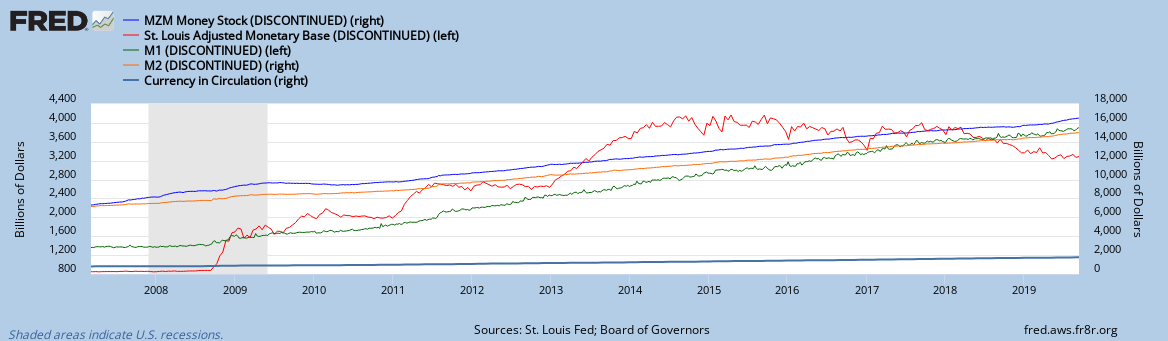
This page is created to monitor the Money Supply.

Base money is basically correlated to the Federal Reserve's Balance Sheet (red chart). When base money is increased, the other monetary aggregates (M1 in green, M2 in yellow, MZM in blue) will follow suit.

The expansion of the money supply is the very definition of inflation. As long as these charts go up, we will have inflation.


Read More
Posted in aggregates, inflation, monetary, money, supply | No comments

Sunday, 21 April 2013

Wage Inflation Vs. Unemployment Rate

Posted on 02:37 by Unknown
This page is created to monitor the Average Hourly Earnings of Production Vs. Unemployment Rate.

When unemployment declines (yellow chart), wages inflate (blue chart).


Read More
Posted in average, earnings, hourly, inflation, rate, unemployment, wage | No comments

Wage Inflation Vs. CPI

Posted on 02:33 by Unknown
This page is created to monitor the Average Hourly Earnings of Production Vs. Consumer Price Index (CPI).

The Average Hourly Earnings (blue chart) are a good indicator for the Consumer Price Index (CPI) (red chart). 

It appears that the CPI is most volatile here, so the important trend to follow is the average hourly earnings.


Read More
Posted in average, consumer, CPI, earnings, hourly, index, inflation, Price, wage | No comments

Thursday, 18 April 2013

Correlation: Wage Inflation Vs. Unemployment Rate Vs. Consumer Price Index

Posted on 11:14 by Unknown
There is an inverse relationship between the unemployment rate and the wage inflation. Whenever people get unemployed, it means the economy isn't doing well. Employers won't be able to raise wages of the people during these difficult times, so you will get a low wage inflation trend (blue line). In these periods, the unemployment rate tends to go up (yellow line).
Chart 1: Wage Inflation Vs. Unemployment Rate
The same can be said the other way round. When the unemployment rate declines, people will demand a higher salary as skilled workers get scarcer. At this stage the wages will inflate.

It is also so that wages correlate highly with the consumer price index (CPI). So if the unemployment rate declines, you can expect a higher CPI as you can see on Chart 2.

So if you don't believe the CPI the government is reporting, you just look at the average hourly earnings. The average hourly earnings were positive in March. So I expect the CPI to increase too.

Chart 2: Average Hourly Earnings Vs. CPI

Read More
Posted in consumer, CPI, index, inflation, Price, unemployment, wage | No comments

Monday, 8 April 2013

Japan got its inflation going

Posted on 14:10 by Unknown
Japan got its inflation allright, USD/JPY just went to 100 and I see 200 coming soon.

USD/JPY

Read More
Posted in inflation, Japan, yen | No comments

Saturday, 19 January 2013

Correlation: Real Interest Rates Vs. Gold Price

Posted on 12:19 by Unknown
I came across a Zerohedge chart and tried to duplicate the chart.

The chart is about how gold goes up when real interest rates (adjusted for inflation CPIAUCSL) on 10 Year Treasuries approach zero.

And as you can see, the red line (10 year treasuries adjusted for inflation) is now exactly at zero. So that is bullish for gold.

The red chart right = Yields on 10 year treasuries adjusted for CPI.
The green chart left = Percentage change in Gold.

Chart 1: Gold (% change) Vs. Real 10 Year Interest Rates (% change)
Very interesting correlation and tool to monitor.
Read More
Posted in 10 year treasuries, bonds, correlation, Gold, inflation, zerohedge | No comments

Thursday, 1 November 2012

Barrick Gold: Abysmal Earnings

Posted on 10:21 by Unknown
As noted before in this article, production costs of mining gold are rising much faster than the price of gold. Previously we saw Kinross Gold having trouble getting their acquired asset from Redback Mining into construction/production due to rising capex and production costs. This time it's Barrick Gold who is stating the same.

The net earnings in Q3 2012 plunged in half from the previous year, making Barrick Gold's earnings P/E ratio go over 10. They revised twice their estimates of capex for their mine at Pascua-Lama, which is pretty unprofessional if you ask me. This tells me that costs of production are rising very rapidly.

In the case of Barrick Gold, the point is that production costs have risen to $592/ounce of gold in 2012, while it was $453/ounce of gold in 2011. That's an increase of 32% in just 1 year.

The gold price was $1600/ounce in 2011 and is $1730/ounce in 2012. That's only an increase of 8%.

This means that gold has to at least rise to $2100/ounce or in other words rise another 20% from this level to even match the inflation costs of production from mining the gold.

I expect that this rise in gold will indeed happen as mining will become more and more difficult at this rate.

Today New Gold will be releasing their earnings, I hope they do better as I have an interest in them...
Read More
Posted in Barrick Gold, Gold, inflation | No comments

Saturday, 25 August 2012

Euro Vs. USD: Take Two

Posted on 05:57 by Unknown
5 months after I wrote the article about the Euro Vs. the USD, it looks like the USD has won the match against the euro. Since April 2012, the euro has lost 5% against the USD. Let's look at what has changed in those months.

Following list gives the most important indicators for the future of a currency:
  • Current account balance of the country
  • Total national debt of the country
  • Inflation rate
  • Interest rate
If the current account balance of the country is positive, a country will export more than it imports. As the population of the country exports more, they will receive more foreign money. This money will then be converted into their own currency, which is then spent or put in their banks. As the foreign money is converted into the money of the country's population their own currency will appreciate in value.

The larger the national debt of the country, the more expensive it will be to sell debt to foreigners. The government will then be obliged to monetize this debt to keep interest rates low and to be able to service this debt. Rising debt load will therefore devalue the currency.

The higher the inflation rate, the lower the currency will go. An example is Vietnam, where the dong lost much of its value due to high inflation.

When interest rates are lower than the inflation rate, there is no incentive for foreigners to buy the currency. There is no incentive to save money. The consequence is a lower currency value.

Let's look at the current statistics:

1) Current account
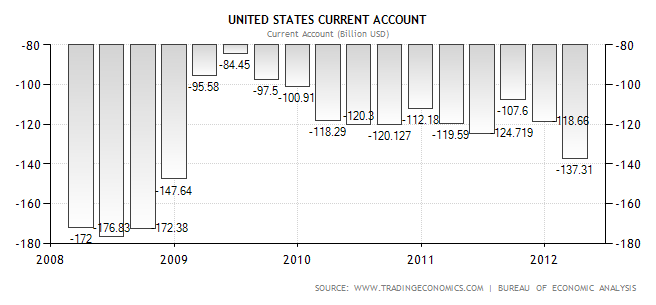
5 months ago, the current account deficit of the US was in the order of $US 110 billion per quarter, which amounted to $US 450 billion per year (2011).

For the Eurozone, the 12-month cumulated seasonally adjusted current account recorded a deficit of EUR 44.9 billion.

Today, the eurozone is posting a current account surplus of 14.9 billion euro in June, while the U.S. is increasing its quarterly deficits to $US 137 billion in the latest quarter.

So in this case, the eurozone is still the winner.

Europe VS USA: 1-0.
Euro Area Current Account (Million euro)


U.S. Current Account (Billion USD)
2) Total National Debt
Total US national debt is $US 16 trillion. Total eurozone national debt to GDP is 88.6%, the GDP is $US 17.578 trillion in 2011, which translates to $US 15.6 trillion in Eurozone debt. So again, Europe wins by a small margin.

Europe VS USA: 2-0

3) Inflation Rate
5 months ago, the inflation rate in the Eurozone was 2.6%, while the inflation rate in the U.S. was 2.9%. Today the inflation rate in the Eurozone is 2.4%, while the inflation rate in the U.S. is 1.4%. This is a significant and surprising decline in inflation rate in the U.S Vs. Europe.

Europe VS USA: 2-1.
Euro Area Inflation Rate
U.S. Inflation Rate


4) Interest Rate
5 months ago, the interest rate in the Eurozone was 1%, while the interest rate in the US was essentially zero. As we already know, Mario Draghi lowered interest rates to 0.75%, but this is still higher than the interest rate in the U.S. (0.25%). Europe VS USA: 3-1
Euro Area Interest Rate

U.S. Interest Rate
     

Conclusion: Europe still wins by 3-1 against the USA, but is losing ground through inflation. Though I think the current account surplus of Europe is the most important positive indicator of the strength of the euro in the future.

Read More
Posted in account, current, Debt, euro, gdp, inflation, Interest, rate, USD | No comments

Tuesday, 17 July 2012

Capacity Utilization in June 2012 at 78.9%

Posted on 08:24 by Unknown
Good news! The capacity utilization rate for the total industry in June 2012 came in at 78.9%, up from 78.7% a month ago (Chart 1).

Interestingly, the mining industry posted its biggest gain in capacity utilization. Mining had a capacity utilization of 89.4%, up from 89.0 % a month earlier.

So no worries, inflation is still in the game.

Chart 1: Capacity Utilization Rate

Read More
Posted in 2012, Capacity, inflation, June, Mining, Utilization | No comments

Thursday, 7 June 2012

The Status on China

Posted on 10:00 by Unknown
We already know China is slowing down, because their imports of key commodities have been going down lately. I summarized this already in this article. We saw that industrial commodity imports were declining, while gold imports and U.S. treasury buying skyrocketed. I believe China has enough tools to keep their real estate and stock markets from falling. To find out how, go to my analysis here.


Read More
Posted in China, commodities, gdp, Gold, inflation, ratio, reserve requirement, RMB, stimulus, treasuries, treasury, USD, velocity, yuan | No comments
Older Posts Home
Subscribe to: Posts (Atom)

Popular Posts

  • GLD trust gold inflow?
    Looks like the media is telling us that the GLD trust physical gold holdings are rising and giving a boost to the precious metals prices. I ...
  • Eric Sprott Taking Silver Off The Market With Offering
    Yesterday, Eric Sprott priced a follow-on offering at $US 200 million, which is a 20% increase in its silver holdings. This will certainly i...
  • Correlation between Bonds and Gold
    Just to be sure that I have this picture (and correlation) logged onto this blog, here is the famous Zero Hedge bonds Vs. gold chart. Chart ...
  • The Current Status on Precious Metals
    Let's do a quick analysis on precious metals here. First off, I said yesterday that China lost interest in gold during the past months i...
  • ECB Rate Cut and its Effect on Euribor
    On Thursday 5 July 2012, the ECB cut its main refinancing rate to 0.75% and its deposit rates to 0%. After LTRO I and LTRO II, we have anoth...
  • Peter Schiff: When Will It Hit The Fan?
    Here's an update from Peter.  The most important sentence in this video was about decoupling of the U.S. dollar and stock markets. Norma...
  • Silver Contango Vs. Silver Price?
    Just for fun I made the same contango chart for silver as I did for copper and had hoped something would come out of it. But surprisingly, t...
  • Capacity Utilization Continues to Improve in November 2012
    We have good news, capacity utilization for the total industry improved in November 2012, from 77.7% the previous month to 78.4% this month....
  • Silver Lease Rates Jump To One Year High (and then fall back to where they were previously)
    Recently, the long term silver (PSLV) (SLV) lease rates jumped to a one year high since May 2011 (Chart 1). On 17 April 2012, the one year l...
  • Capacity utilization rate April 2012 79.2% above estimates
    In my previous article I pointed out how important it is to follow the capacity utilization rate to estimate the prices of gold and silver ...

Categories

  • 10 (1)
  • 10 year treasuries (1)
  • 1987 (1)
  • 2012 (7)
  • 30 (1)
  • account (1)
  • acquisitions (1)
  • adjustable (1)
  • ADP (1)
  • Advantage (1)
  • aggregates (2)
  • AGQ (1)
  • agriculture (1)
  • Akamai Technologies (1)
  • alert (1)
  • Alex Jones (1)
  • Allan Meltzer (1)
  • Allana (1)
  • Allana Potash (1)
  • amber gold (1)
  • America (1)
  • and (2)
  • Angela (1)
  • APMEX (5)
  • applications (1)
  • April 2012 (1)
  • arbitrage (2)
  • Arthur (1)
  • asia (2)
  • Asian (1)
  • At. Augustine Gold (1)
  • Atlantic Economy Summit (1)
  • AUD (1)
  • Australian dollar (1)
  • automotive (2)
  • average (3)
  • Avino (1)
  • bac (2)
  • backing (1)
  • backwardation (6)
  • balance (8)
  • balance sheet (3)
  • Baltic (1)
  • Baltic Dry Index (1)
  • Bank (10)
  • Bank of America (1)
  • Bankrupt (1)
  • bankruptcy (2)
  • banks (3)
  • bar (1)
  • Barclays (1)
  • Bargain (1)
  • Barrick Gold (1)
  • base (1)
  • base money (1)
  • Bass (1)
  • BCS (1)
  • beleggerscompetitie (4)
  • Belgium (10)
  • Ben (3)
  • Ben Bernanke (4)
  • Bernanke (4)
  • Bernstein (1)
  • BHP (1)
  • bitcoin (8)
  • blog (1)
  • BNP (1)
  • bond (14)
  • bond yields (1)
  • bonds (33)
  • boom (1)
  • Brad Cooke (1)
  • Brazil (1)
  • brent (2)
  • Brink's (2)
  • brother (1)
  • BrotherJohnF (1)
  • bubble (2)
  • budget (2)
  • Budget Deficit (1)
  • Buffett (2)
  • building (2)
  • bullion (1)
  • bullish (1)
  • buyback (1)
  • buying (1)
  • c (1)
  • calculation (2)
  • Cambridge (1)
  • Canada (1)
  • Capacity (8)
  • Capacity Utilization (7)
  • Capesize (1)
  • capita (1)
  • Capstone Mining (1)
  • car crash (1)
  • Case-Shiller (1)
  • Casey (1)
  • Cash is Trash (1)
  • cattle (1)
  • ceiling (4)
  • celente (2)
  • cement (1)
  • central (2)
  • CFTC (3)
  • Chaudhary (1)
  • Chicago (2)
  • China (48)
  • China Construction Bank (1)
  • CHK (1)
  • chocolate (1)
  • Citigroup (2)
  • city (1)
  • claims (3)
  • CLF (1)
  • cliff (3)
  • CME (11)
  • cnbc (2)
  • CNT depository (1)
  • coal (2)
  • cocoa (1)
  • COFER (2)
  • coffee (1)
  • comedy (1)
  • COMEX (33)
  • commercial (1)
  • Commerzbank (1)
  • commodities (4)
  • commodity (1)
  • competition (1)
  • composition (1)
  • Conan (1)
  • Conference (2)
  • congress (1)
  • consumer (4)
  • consumption (2)
  • Contango (26)
  • contraction (1)
  • convention (1)
  • copper (34)
  • copper contango (1)
  • corn (2)
  • Corp (1)
  • correlation (54)
  • correlations (7)
  • cost (5)
  • costs (1)
  • COT (4)
  • cotton (1)
  • council (1)
  • country (2)
  • county (1)
  • cover (1)
  • CPI (5)
  • crash (2)
  • CRB (3)
  • credit (2)
  • Credit Agricole (1)
  • Croatia (1)
  • crude (3)
  • currency (3)
  • current (1)
  • curve (1)
  • Cut (1)
  • Cyprus (7)
  • Da (1)
  • daily (1)
  • Dan Norcini (1)
  • David (1)
  • David Morgan (2)
  • DB (1)
  • de-peg (1)
  • Debt (30)
  • debt ceiling (2)
  • debt limit (1)
  • December (1)
  • decoupling (7)
  • default (4)
  • deficit (7)
  • deflation (2)
  • delivery (1)
  • Demand (6)
  • Denmark (2)
  • Denninger (1)
  • deposit (8)
  • deposit facility (1)
  • deposits (3)
  • diamond (1)
  • Discouraged (1)
  • disposable (1)
  • dividend (1)
  • DJP (1)
  • DNC (1)
  • dollar (2)
  • domestic (1)
  • Doug (1)
  • Dow (7)
  • drop (1)
  • Dry (1)
  • durable (1)
  • dwcf (1)
  • earnings (4)
  • earnings per share (1)
  • ECB (6)
  • economy (1)
  • Ecuador (1)
  • elections (1)
  • electricity (2)
  • eligible (2)
  • Embry (1)
  • Employment (1)
  • Endeavour (1)
  • Endeavour Silver (2)
  • Engelhard (1)
  • eps (3)
  • equities (3)
  • equity (1)
  • equity markets (1)
  • Eric (6)
  • Eric Sprott (1)
  • estate (2)
  • estimate (1)
  • ETF (3)
  • Ethiopia (1)
  • Ethiopian Potash (1)
  • eur (1)
  • Eureka (1)
  • Euribor (2)
  • euro (8)
  • Europe (7)
  • European Union (1)
  • Eurozone (1)
  • exchange (1)
  • EXK (1)
  • expansion (1)
  • experiment (4)
  • exploration (1)
  • export (1)
  • exports (1)
  • Exposure (1)
  • external (1)
  • Faber (3)
  • family (1)
  • Faustian (1)
  • fed (2)
  • federal (10)
  • federal reserve (3)
  • Fertilizer (1)
  • Financial Services Committee (1)
  • First (3)
  • First Majestic Silver Corp. (1)
  • fiscal (3)
  • fiscal cliff (1)
  • fixed (1)
  • food stamps (1)
  • food stamps hire people (1)
  • foreigners (4)
  • forex (1)
  • Forum (1)
  • forward (1)
  • franc (1)
  • France (3)
  • Fraser (1)
  • French (1)
  • fund (1)
  • funds (3)
  • gas (1)
  • Gazprom (1)
  • gdp (25)
  • George Soros (1)
  • Germany (3)
  • gld (3)
  • GNP (1)
  • GOFO (4)
  • Gold (130)
  • gold money index (1)
  • golden cross (1)
  • Goldman (1)
  • Goldman Sachs (2)
  • goldonomic (1)
  • goods (1)
  • got gold report (1)
  • government (2)
  • great (1)
  • Great Depression (2)
  • Greece (8)
  • Greg (1)
  • gross (1)
  • growth (1)
  • GS (1)
  • GSK (1)
  • Hampshire (1)
  • Hang Seng (1)
  • Happy New Year (1)
  • Hedge (1)
  • Hewlett Packard (1)
  • Hitler (1)
  • HMI (1)
  • holding (1)
  • holdings (4)
  • Hole (1)
  • Hollande (4)
  • home (1)
  • hong (7)
  • Hong Kong (11)
  • hour (4)
  • hourly (3)
  • Housing (8)
  • housing market index (1)
  • HSBC (1)
  • Hunter (1)
  • Hyperinflation (3)
  • IMF (1)
  • import (14)
  • imports (16)
  • income (1)
  • index (13)
  • India (1)
  • industrial (2)
  • industry (1)
  • inflatiion (1)
  • inflation (11)
  • iniflation (1)
  • initial (3)
  • initial claims (1)
  • initiative (1)
  • Insider (1)
  • insider trading (1)
  • institute (1)
  • interconnectivity (1)
  • Interest (9)
  • interest payment (1)
  • Interest Rates (1)
  • inventory (1)
  • investment (2)
  • Investor (1)
  • Iran (4)
  • Ireland (1)
  • Iron (2)
  • Iron ore (2)
  • Irwin (1)
  • Israel (2)
  • Italy (4)
  • J.P. Morgan (7)
  • J.P. Morgan Chase (1)
  • Jackson (1)
  • James (5)
  • James Turk (2)
  • Japan (10)
  • jesse jackson (1)
  • Jim (1)
  • Jim Rogers (1)
  • Jim Sinclair (1)
  • JNJ (1)
  • job cuts (1)
  • jobless (2)
  • John (3)
  • John Davis (1)
  • Jones (2)
  • JP Morgan (1)
  • jpm (1)
  • July (1)
  • June (2)
  • junk (3)
  • Karl (1)
  • keiser (2)
  • king world news (1)
  • Kohler (1)
  • kong (7)
  • KWN (2)
  • Kyle (1)
  • Kyle Bass (1)
  • laptop (1)
  • large commercial (1)
  • Las (1)
  • LBMA (3)
  • LCNS (9)
  • Lease (8)
  • Lease rate (3)
  • lease rates (2)
  • Lecture (1)
  • lending (1)
  • leverage (1)
  • Liberty (1)
  • LIBOR (3)
  • Lloyds (1)
  • LME (3)
  • Loans (1)
  • london (2)
  • long (1)
  • LTRO (3)
  • lumber (1)
  • M0 (1)
  • M1 (1)
  • M2 (1)
  • M3 (2)
  • Majestic (3)
  • Maloney (1)
  • manager (1)
  • manipulation (1)
  • Marc (3)
  • Marc Faber (11)
  • March (1)
  • margin (1)
  • marginal (4)
  • market (5)
  • Mastercard (1)
  • maturity (2)
  • Mauldin (1)
  • max (2)
  • max keiser (3)
  • May (1)
  • MBS (5)
  • Melvin (1)
  • merger (1)
  • Merkel (1)
  • metal (1)
  • metals (7)
  • Metdist (1)
  • MF global (1)
  • Michael (2)
  • Middle East (1)
  • Mike (1)
  • Mike Maloney (2)
  • miners (2)
  • mines (1)
  • Mining (4)
  • minister (1)
  • Mint (1)
  • monetary (1)
  • money (4)
  • Moneyshow (1)
  • monitoring (1)
  • Monitoring of decoupling (1)
  • Morgan (1)
  • Morgan Stanley (1)
  • mortgage (6)
  • Moustache (1)
  • moving average (1)
  • MZM (3)
  • natural (1)
  • Natural gas (3)
  • Neeraj (1)
  • Negative (3)
  • net (4)
  • Netherlands (2)
  • New (1)
  • News (1)
  • nickel (1)
  • Noel (1)
  • Nomura (2)
  • non farm payroll (1)
  • non-farm payroll (1)
  • NOS (1)
  • Novartis (1)
  • O'Brien (1)
  • obesity (1)
  • Occupy (1)
  • Offering (1)
  • oil (9)
  • oil embargo (1)
  • Okun (1)
  • olivut resources (1)
  • OLV (1)
  • Onion (1)
  • open (3)
  • orders (1)
  • ore (1)
  • outflow (1)
  • outlay (4)
  • outlays (1)
  • overnight (1)
  • P/B (1)
  • P/E (2)
  • palladium (4)
  • Pan American Silver (1)
  • Panamax (1)
  • paper (1)
  • Paulson (1)
  • payment (1)
  • payroll (3)
  • pegging (1)
  • pending (1)
  • Pentagon (1)
  • Pento (2)
  • permit (2)
  • personal (1)
  • Peter (13)
  • Peter Schiff (13)
  • petition (1)
  • Pfizer (1)
  • pharmaceutical (1)
  • phys (1)
  • physical (2)
  • piano (1)
  • PIIGS (6)
  • platinum (7)
  • PMI (11)
  • Ponzi (1)
  • Poor's (2)
  • population (1)
  • Portugal (3)
  • positions (3)
  • Potash (1)
  • Potemkin (1)
  • PPLT (1)
  • precious (4)
  • premium (25)
  • president (1)
  • Price (16)
  • private (1)
  • product (1)
  • production (7)
  • profit (1)
  • PSLV (5)
  • public (3)
  • purchasing (1)
  • QE (1)
  • QE3 (6)
  • radio (1)
  • rally (2)
  • rate (27)
  • rates (2)
  • ratio (11)
  • RBS (1)
  • real (4)
  • Real estate (4)
  • receipt (1)
  • recession (1)
  • recycling (1)
  • red (1)
  • referendum (1)
  • regions (1)
  • registered (3)
  • registered gold (1)
  • repatriation (1)
  • report (4)
  • requirement (1)
  • reserve (12)
  • reserve currency (1)
  • reserve requirement (1)
  • reserves (3)
  • Resource (1)
  • revenue (2)
  • revision (1)
  • revisions (1)
  • Rhodium (1)
  • Rickards (1)
  • RJA (1)
  • RMB (1)
  • Road (1)
  • Roche (1)
  • Royal Canadian Mint (1)
  • run (1)
  • Russia (2)
  • Sachs (1)
  • sales (1)
  • SAU (1)
  • Saudi Arabia (1)
  • Savings (5)
  • scheme (1)
  • Schiff (13)
  • Scott Minerd (1)
  • scrap (3)
  • second quarter (1)
  • sector (1)
  • securities (1)
  • Seminar (1)
  • sentiment (2)
  • SGS (1)
  • Shanghai (15)
  • share (1)
  • sheet (7)
  • SHIBOR (1)
  • short (6)
  • short positions (1)
  • shortage (2)
  • shorting (1)
  • Show (1)
  • Silva (1)
  • silver (90)
  • Silver glitch (1)
  • Silver Lake Resources (1)
  • Singapore (1)
  • single (1)
  • Sipef (1)
  • slv (3)
  • Societe general (1)
  • Soros (1)
  • soybean (1)
  • soybeans (1)
  • Spain (4)
  • Spain unemployment (1)
  • SpainC (1)
  • Spanish (1)
  • SPDR (1)
  • spending (2)
  • Spiegel (1)
  • SPPP (2)
  • SPR (1)
  • spread (1)
  • Sprott (14)
  • stand (1)
  • standard (3)
  • Standard and Poor's (5)
  • starts (1)
  • stimulus (2)
  • stock (19)
  • stocks (2)
  • strategic petroleum reserve (1)
  • Street (1)
  • stress (1)
  • Student (1)
  • sugar (1)
  • supply (5)
  • Supramax (1)
  • surplus (1)
  • surprise (1)
  • Swaps (1)
  • Swiss (2)
  • Switzerland (4)
  • takeover (1)
  • target (1)
  • tax (8)
  • taxation (1)
  • taxes (1)
  • Tekoa (1)
  • test (1)
  • testify (1)
  • The Real Crash (1)
  • Theory (2)
  • TLT (1)
  • total (4)
  • trade (1)
  • trade deficit (1)
  • transport (1)
  • treasuries (18)
  • treasury (10)
  • treasury holdings (2)
  • trust (3)
  • turbo (1)
  • Turk (5)
  • U.S. (21)
  • U.S. debt (1)
  • U.S. dollar (1)
  • U.S. Mint (2)
  • U.S. treasuries (1)
  • U.S. treasury holdings (1)
  • U3 (1)
  • U6 (1)
  • unemployment (17)
  • Unemployment rate (1)
  • united states (1)
  • up (1)
  • US (7)
  • USA (1)
  • USD (8)
  • Utilization (8)
  • Valcambi (1)
  • valuation (1)
  • Vegas (1)
  • velocity (5)
  • Visa (1)
  • volatility (1)
  • wage (3)
  • wages (1)
  • Wall (1)
  • Wall Street Journal (1)
  • War (3)
  • warehouse (1)
  • Warren (2)
  • wedge (1)
  • Western Potash (1)
  • wheat (2)
  • worker (1)
  • world (1)
  • World Market Window (1)
  • wrap (1)
  • WTI (1)
  • Yahoo (1)
  • year (2)
  • yen (2)
  • Yeul (1)
  • yield (11)
  • yields (2)
  • yuan (1)
  • zero (6)
  • Zero Hour (2)
  • Zero Hour Debt (1)
  • zerohedge (2)
  • zinc (1)

Blog Archive

  • ▼  2013 (243)
    • ▼  August (7)
      • GLD trust gold inflow?
      • Peter Schiff: Stand-Up Comedian
      • Gold Lease Rate Higher, Registered COMEX Gold Lower
      • The Declining Trade Deficit: Not As Rosy As You Wo...
      • China Gold Imports from Hong Kong: Steady in June ...
      • Tax Receipts Vs. Savings Rate
      • Gold Backwardation Explained By James Turk
    • ►  July (14)
    • ►  June (34)
    • ►  May (23)
    • ►  April (53)
    • ►  March (36)
    • ►  February (33)
    • ►  January (43)
  • ►  2012 (257)
    • ►  December (42)
    • ►  November (26)
    • ►  October (30)
    • ►  September (20)
    • ►  August (25)
    • ►  July (32)
    • ►  June (30)
    • ►  May (29)
    • ►  April (23)
Powered by Blogger.

About Me

Unknown
View my complete profile